Saturday, February 25, 2012

The Intriguing Lokot-Lokot

Lokot-lokot


Fascinated by its name, lokot-lokot was not really prominent in the entire Philippines. When I first heard the word "lokot", the first thing that it crossed in my mind is like a thing that you rolled. Then my guessed had not missed.


THE ORIGIN OF THE “LOKOT-LOKOT”

The Muslim communities in the Zamboanga Peninsula are known for the variety of delicacies they produce during special occasions, especially the “Hariraya” or the feast of the Eid-il-Fitr, which celebrates the end of the fasting month of Ramadan. Foremost among the goodies is the golden brown curious-looking “locot-locot” or “jaa” as the villagers call them. A lot of people actually consider it as the “queen” of the delicacies because it is the most popular and frequently asked for by guests.

It is fascinating to watch someone who is seeing the locot-locot for the first time. After asking what it is, he instantly wants to taste it, and as it crunches in his mouth his eyes light up with pleasure and he nods approvingly. Some give the okay sign or put up their thumbs enthusiastically.

If you ask how the locot-locot came about, its origin is sadly lost in the mist of time. Fortunately the ancestors of the present Muslims passed on its technology to the next generations down through the millennia. Some people believe it came from Malaysia or Indonesia as the region, including the southern Philippines, was once a part of the great Madjapahit Empire during the 13th and 14th centuries. The seafaring Malays probably brought it to our shores as they wandered freely throughout the area.

Legend has it that it was the locot-locot that inspired the appearance of the Chinese noodles, such as the sotanghon, bihon and miswa. It is said that several attempts of the people of China to imitate the locot-locot led to their creation, which over time became famous delicacies themselves.

Making locot-locot requires a lot of time and hard work. First the grains of rice have to be pounded into flour. Then the correct proportions of water and sugar are added to create a gooey mixture which is poured into a container made of coconut shell with regular small holes at the bottom, all the while it is poised above a frying pan filled with hot oil. As it turns golden brown it is deftly and expertly folded and shaped in the pan with a couple of wooden spoons to create the desired look. Watching a cook do the locot-locot is like watching an artist in motion.

You can tell a house is making locot-locot by the rhythmic sound coming from the kitchen made by the beating of the coconut container to pour out the dough into the frying pan. Some purists say if the rhythm is out of sync the locot-locot will not look attractive and enticing.


(Other infos came from the Facebook page of Taluksangay Muslim Delicacies)
Pin It now!

Friday, February 10, 2012

The Two Variations of Ilocandia Empanada

Vigan Empanada

Batac Empanada


Here on earth, everything have its own contrast. They might be the same in physical aspect but totally different its innate ability or maybe they have the same name but the outside look speaks for itself.

Why I have said that statement? Well, it's because our feature food for today is all about this. Although this food has came from the northern part of Ilocos. It has its own unique quality which differs from each other. I am talking to the mouth watering street food empanada.

Empanada has become popular in the Philippines through the introduction of the colonizers, the Spaniards. It was believed that this food came from Galicia, an autonomous community in northwest Spain.

According to Wikipedia, Empanada is a stuffed bread or pastry baked or fried.

The name comes from the verb empanar, meaning to wrap or coat in bread. Empanada is made by folding a dough or bread patty around the stuffing. The stuffing can consist of a variety of meats, cheese, huitlacoche, vegetables or fruits among others.


With this definition, there is no definite ingredients as to what are these specifically. It might be an absence or a presence of one of those composition but the one that wrap the food may define the food as empanada.

Looking back at the origin of empanada, the Ilocanos have been one that were influenced by this food. So they created their own unique style of preparing this food with the characteristic that may define their palatable taste.

Ilocos is divided into two, the Norte and the Sur. They have the same dialect but different in preparing the empanada. The Norte which specifically from Batac, empanada's are cook using a thicker crust of dough. Livelier color attracts also the eater because they are using "achuete" to make it into orange. While the Sur version from Vigan is the opposite of the one I mention. Thinner with crisper crust even when its cold and has a pale color.

Basically, this two kinds of empanada have the same compositions, rice flour for the crust dough, fresh egg and mongo sprout filling, grated green papaya and Ilocos longanisa (take note there are also different version of longanisa from both places). The cooking procedure is the same, it is deeply fried on a boiling cooking oil.

In Vigan they dip the empanada in Ilocos black vinegar (Sukang Iloko) while in Batac they use catsup as a sauce. This variations make them totally different when it comes to taste.

Although I have tasted them both, I found it very arousing and I am dreaming them again rolling inside my mouth.

Here are two videos of two different types of cooking empanada from Ilocandia:


Photos from www.flickr.com
Pin It now!

Monday, January 30, 2012

Sizzling Sisig, the Unexpected Delicacy

Sizzling Sisig

There are good things that happen unexpectedly when we experiment. Experimentation is a process to discover something new that could lead to create another thing. This had happened to Lucia Cunanan of Angeles City, Pampanga when she discovered sisig in 1974, one of the most favorite dishes in karinderia or even in a fine dining restaurant. This resulted to the prominent Aling Lucing's and was even crowned as the "The Original Sisig Queen".

Sisig is cook using a sizzling plate. The main ingredients of this dish is the pigs's head and liver that's boiled, chopped, to be seasoned with calamansi, onions and red chili peppers. It is also known as a "pulutan" but others make it as a viand and being paired with steam rice. The crispy and cruchy meat makes it more enticing plus the aromatic odor will definitely capture your smell.

Although there are other restaurants who tried to serve this dish, for me the best among them are from Sisig Hooray, Gerry's Grill and Giligans.

Today, there are other variants of sisig. For health conscious eaters be not worry they are now come in chicken, bangus and tuna.


Photo from Our Awesome Planet VGZ6M34KA2QK
Pin It now!

Thursday, January 26, 2012

It's More Fun With Sinigang

Sinigang


If there's one dish that Filipinos may call their own, probably it's the Sinigang.

Sinigang is a kind of stew dish known for its sour taste. It's often attach to the fruit of tamarind or sampalok. Every region has its own ingredient to use depending on the abundance of the fruit. Some use guava, kalamansi (a kind of citrus fruit), santol(Sandoricum koetjape), green mango, camias ginger lily, and others that has the sour characteristic. Due to seasonal availability of these fruits, Filipino has created the powdered soup base or bouillon cubes in tamarind base.

Sinigang can be apply in most kind of meats. The most prominent ingredient maybe the pork. I have also tried the chicken and it's fine, it more often called it as Sinampalukang Manok. Beef is rarely use. Fish like tilapia and milk fish are also common in seafoods. Likewise with shrimp which is the best among the sinigang main ingredient.

Sinigang cannot be called authentic in the absence of vegetables. In preparing sinigang, you should have tomatoes, onions, gingers (used to relinquish the fishy smell), okra, taro corms (gabi), daikon (labanos), water spinach (kangkong), string beans(sitaw) and eggplant(talong). Most Filipinos like sinigang with a kick, so they drop a green finger pepper to add some spice to the dish.

So here's the recipe of a Sinigang na Baboy:


Ingredients:


  • 1/2 Kilo of Pork meat 
  • 2 pcs of pelled garlic 
  • 1 pc of chopped onion 
  • 3 pcs of sliced tomatoes 
  • 2 tablespoon of patis (fish sauce) 
  • Tamarind (you can use the real fruit or the powder base) 
  • 2 pcs of sliced taro corms, 
  • 6-8 strand of string beans (cut into 2 inches long)
  • 1 pc of fine slice of daikon
  • a bundle of water spinach
  • 1 - 2 pcs of  green finger pepper


How to Prepare and Cook:


  • Boil the pork meat on a 4 bowls of water in a casserole. Cook until it  becomes tender. Separate the meat but don't throw the soup.
  • When the meat is tender, saute the garlic, onion and tomatoes in a pan.
  • Put the fish sauce to taste.
  • Simmer the tender meat and taro.
  • Cover and let it boil for about 10 minutes.
  • Transfer the soup from the casserole.
  • Boil it again for 5 minutes together with the tamarind.
  • Add the daikon and green finger pepper.
  • After 5 minutes, you can put the water spinach and cover it again.
  • Now, you serve the Sinigang na Baboy and enjoy the sour taste.

Here's an another way of preparing your Sinigang. A step-by-step guide.


Photo from Hubpages.com
Pin It now!

Monday, January 23, 2012

The Two Version of Chicken Inasal

Chicken Inasal


When the first bite of Chicken Inasal landed in my tongue, I thought that was already heaven for me. I still recall that first experience in a branch of Mang Inasal. That was the time when this barbeque fastfood was still 100 percent controlled by Edgar Sia II of Iloilo. Later, it was acquired by Jollibee Foods Corporation for 3 billion pesos in October of 2010 for about 70 percent of the company.

So what makes Inasal different from an ordinary chicken barbeque?

The smoked flavor added by cooking the meat on a hot charcoal grill imbibes the marinade and makes the dish tastier. This dish is also distinct for its yellowish color brought about by the application of achuete or annatto oil.

Chicken Inasal for me really suit the taste of the Filipino customers. Unlike a typical grilled barbeque chicken, this dish has different ingredients and preparation. You'll be needing time and effort before you could taste the fruit of your hardship. Normally, the chicken meat will be marinade together with the ingredients for several hours or better if it's overnight.

Before Mang Inasal has catches the taste of the Filipino, Bacolod's Inasal was already been there. I was fascinated how could this variant of inasal different from that of Iloilo version until I tried to drop-by at Joel Torre's "JT’s Manukan Grille".

As per my conclusion, Bacolod Inasal has a slightly sour taste while the Iloilo Inasal is more into sweeter side. Ilonggo's put sugar on their ingredients. Although the are not the same but I like them both.


A version of the Iloilo's Chicken Inasal that I found at Wikipilipinas that you must try:


Ingredients

1 whole chicken, cut into 6 parts (legs, wings, breasts)

Marinade
  • 1 head garlic, macerated
  • 2 tbsps. chopped ginger
  • 1 tbsp. brown sugar (Note: this is optional if you want use the Bacolod way)
  • 1/3 cup sinamak, (native coconut vinegar)
  • 10 pieces calamansi, extract the juice
  • 3 stalks tanglad (lemon grass), julienne
  • salt and coarsely ground pepper

Basting Sauce
  • 1/2 cup Star Margarine
  • 1/4 cup atsuete (annatto seeds) oil
  • salt and pepper
  • large bamboo skewers
  • charcoal for grilling


Preparation and Cooking Process:

  • In a large bowl, place the garlic, ginger, vinegar, a small amount of sugar, tanglad, calamansi juice, salt, and pepper. Mix all the ingredients then add the chicken meat. Lightly rub the marinade on the meat. Place chicken in the chiller and let sit. After 30 minutes, turn the meat and let it sit for another 30 minutes. It is not ideal to marinate the meat overnight since the acid of the vinegar will completely break down the enzymes of the meat.
  • Meanwhile in a saucepan, over low fire, put margarine and annatto seeds. For few minutes, continue stirring until the margarine melts and the annatto seeds are well infused and have developed a deep orange color. Turn off heat then add a small amount of salt and pepper to taste.
  • After marinating the chicken, put several slits on the part near the bone to help with cooking the meat fully. Skewer the meat and cook over hot charcoal grill, skin side down, basting it once in a while. As much as possible do not turn the meat more than twice since the result will be drier meat.
  • Serve while hot together with steamed rice paired with grilled oysters and sinamak or soy sauce with calamansi and siling labuyo (red chili peppers).
Photo from Flavours of Iloilo
Pin It now!

Saturday, January 21, 2012

Sausages? How to Differentiate Vigan and Lucban Longganisa


Longaniza or longganisa in Filipino, is a kind of sausage that was first introduced by the Spaniards during the colonization era. It is closely similar to chorizo where in a ground pork is the main ingredient. Region by region has its own trademark in preparing it. But in the Philippines, the most famous maybe of its variants are the Lucban and Vigan.


Lucban Longganisa

From the province of Quezon, aside from being the Pahiyas Festival Capital, Lucban is also known because of its longganisa. Its sausage is identified for its aromatic and garlicky smell. From the ground pork, they mixed herbs such as the oregano, a squeeze juice of lemon grass and basil leaves. Carefully stuffed on a pork casing using the funnel and tie both ends with a buntal fiber. Typically, Lucban longganisa has a reddish color because of achuete.


Vigan longganisa

Similar to Lucban longganisa, the Vigan version has also the garlic flavor. But aside from being garlicky it is also sourly and salty with the distinct pungent aroma. Thanks to the Ilocos native garlic, a small but powerful spices. These garlic bits are finely combine and blended to the ground pork. The annato powder, paprika, ground pepper, kinchay, and sukang iloko will complete the sausage. The color of this sausage is more into yellowish.

The next time you buy from the supermarket you can now differentiate Lucban from Vigan longganisa.


Photos from clarissa623.wordpress.com and facebook.com
Pin It now!

Friday, January 20, 2012

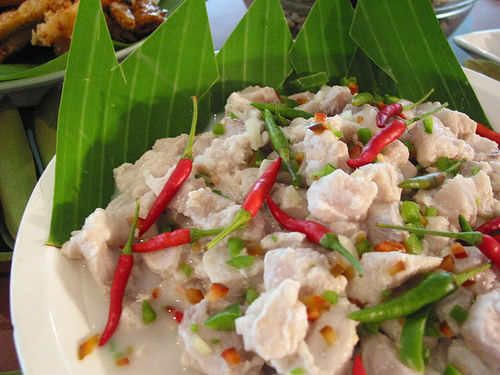
Fish Salad or Kinilaw

Kinilaw


Because Philippines is a country that is diverse with multi-cultural ethnicity, preparing dishes in every region have different style, taste and even ingredients. One of this food is the Kinilaw.

Basically, Kinilaw is a method of cooking raw meat in either from seafoods just like fishes and shrimps, beef, goat and some also use the exotic dog meat, using vinegar, ginger, onions and squeeze juice from citrus. Frequently, fish kinilaw is the most popular among them.

Kinilaw na isda is also consider as a viand. It is best partner with a hot steamed rice. Others also prepare this while on drinking session or even as an appetizer.


Prominent Ingredients of a Fish Salad:

  • ½ kilo fish (sliced in cubes)
  • 200 mL vinegar (from coconut sap)
  • 3 tbsp lemon or kalamansi juice
  • 1 small chopped red onion
  • 2 tbs of chopped ginger
  • 2 pcs of chopped red chili pepper(siling labuyo), optional
  • Salt and vetsin (msg) to taste


How to Prepare:
  • Marinade fish in coconut vinegar for at least 30mins to an hour
  • Drain and combine with all ingredients
  • Let stand refrigerated for about another 30mins to an hour.
  • Then serve.


Photo from www.edrosolano.com
Pin It now!

 
Design by Free WordPress Themes | Bloggerized by Lasantha - Premium Blogger Themes Bloggers.comFood & Drink - Top Blogs PhilippinesBlog DirectoryPhilippines Blog Directory Food & Drink Blogs
Food & Drink linksTop Recipes Sites